
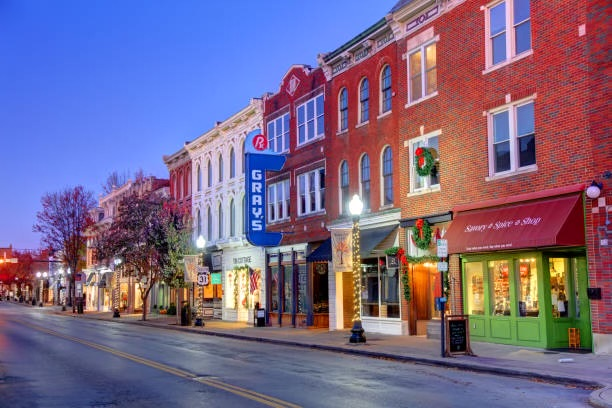
Franklin, Tennessee, was founded on October 26, 1799, when the Tennessee General Assembly created both the city and Williamson County out of the parent county of Davidson. That single September of legislation gave Franklin the distinction of being the county seat from its very first day, a role it still holds more than two centuries later.
Named for Benjamin Franklin, and the County Seat From the Start
The city's own history explains the name: Williamson County honors Dr. Hugh Williamson, a North Carolina physician, member of the Continental Congress, and a signer of the Constitution, who named the new town for his close friend Benjamin Franklin. The layout itself was planned almost immediately. Surveyor Abram Maury, Jr. laid the town out around the year 1800, dividing roughly 109 acres into 16 blocks and 188 lots gathered around a 2-acre public square. Franklin was formally incorporated as a town in 1815.
A Small County Seat With a Civil War Turning Point
For most of its first two centuries Franklin was a tranquil county seat. Before the Civil War, Williamson County was one of the wealthiest counties in Tennessee, and the Tennessee Encyclopedia notes Franklin sat at the center of its plantation economy, with about 1,500 residents by 1835. Then came November 30, 1864, when the Battle of Franklin turned the town into a national story. Historians often call it the five bloodiest hours of the Civil War: Confederate forces under General John Bell Hood launched a frontal assault on entrenched Union lines, suffering roughly 6,600 to 7,000 casualties, including six generals killed. The Carter House, still standing near downtown, sat in the center of the heaviest fighting and is preserved as a state historic site today.
Why Main Street Still Feels Historic
What visitors notice first about Franklin is how much of that history is still visible. The Downtown Franklin Historic District spans roughly sixteen blocks of the city's oldest section, with antebellum and Victorian homes and storefronts lining Main Street. That preservation did not happen by accident. Alarmed by suburban development in the late 1960s, residents founded the Heritage Foundation of Franklin and Williamson County in 1968, and the group has led the effort to protect Main Street and the surrounding battlefield and green space ever since. It is the reason a stroll down Main Street reads so differently from a typical suburb, and it is a big part of why Franklin shows up on so many best small-town lists.
Grounded in History, Still a Place People Want to Be
That blend of a two-century heritage and a modern community is exactly what draws so many buyers to Franklin. We see it every day, whether we are walking a client through a historic brick home near the square or touring newer neighborhoods just minutes away. If Franklin's story has you curious about what is available here today, start by browsing our neighborhood guide or schedule a consultation, and we can find the right corner of this historic city for you.
Sources: City of Franklin, TN, "History of Franklin, TN"; the Tennessee Encyclopedia, "Williamson County"; and the Advisory Council on Historic Preservation, "Franklin, Tennessee." Casualty and district figures reflect these published historical accounts.
Dreaming of a historic home near the square? Read our guide to what Franklin is known for, or get the family perspective on schools before you start the search.

Mike Battistelli, Team Lead
SouthernLUXE Partners
REAL Broker
TN Lic: 372786